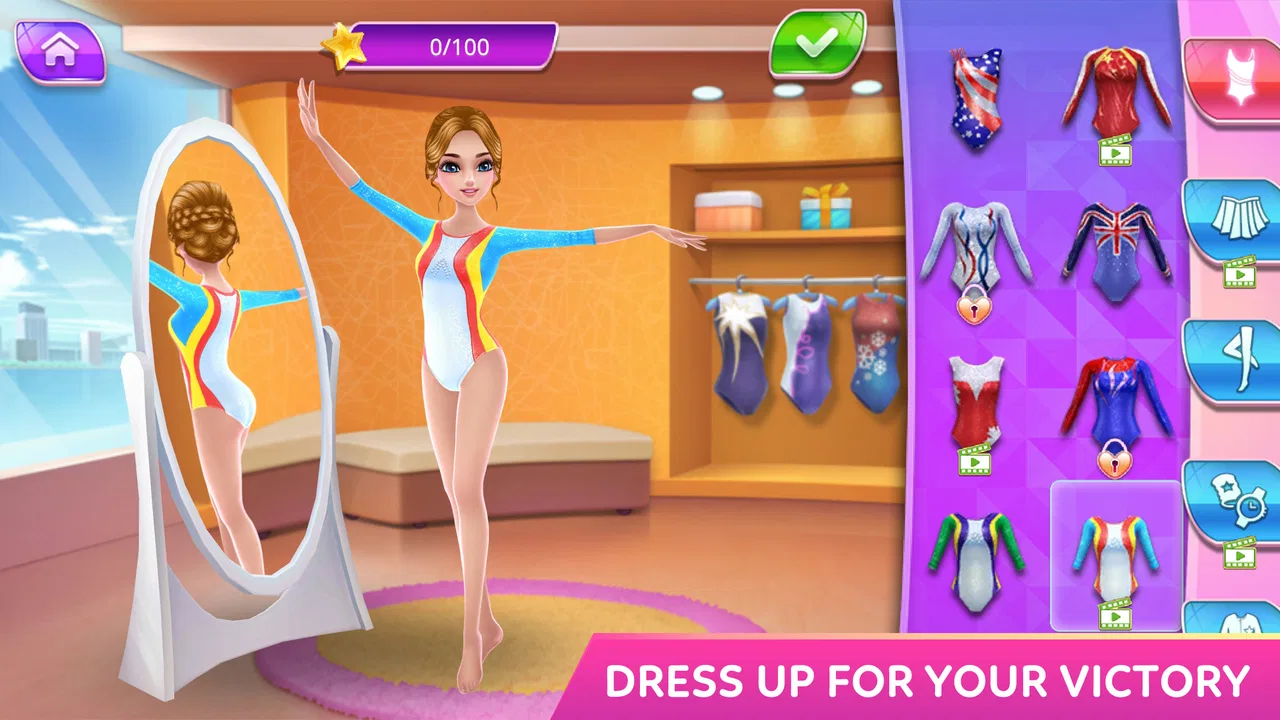
Gymnastics Superstar Star Girl
- 4.5
- Rating
- 50.00M
- Installs
- Free
- Price

 Analysis by App-foxy
Gymnastics Superstar Star Girl is a role-playing game built around the fantasy of becoming a successful gymnast. I approached it as a light, character-focused mobile game rather than a serious training simulator, and that distinction matters from the first few minutes. The appeal is easy to understand: you get to step into the world of gymnastics, prepare a character for performances, and enjoy the kind of makeover-and-progress loop that makes short play sessions feel rewarding.
What I like most is that it turns a familiar sports dream into something approachable. You do not need to know the rules of competitive gymnastics to understand the basic attraction. The game is aimed at players who enjoy dressing up a character, guiding her career, and seeing a performance come together. At the same time, anyone looking for precise athletic controls, deep scoring strategy, or a realistic simulation should keep expectations modest. This is a casual role-playing experience with gymnastics as its theme, not a replacement for a dedicated sports game.
What the game feels like in everyday play
In my experience, the best way to enjoy this game is in short sessions. It suits the moment when you have a few minutes to spare and want a clear, friendly activity rather than a complicated system to learn. A younger player might use it to create a favorite gymnast and play through a performance routine, while an older fan of casual mobile games may enjoy the combination of appearance choices and career-style progression.
You May Also Like

 AccuWeather: Weather Radar
AccuWeather Review: A Quick, Clear Forecast for Everyday Decisions
For everyday plans, the best forecast is the one you can understand quickly. AccuWeather makes rain timing, radar, and local conditions easy to act on, with a few trade-offs.

 Hill Climb Racing
Why Hill Climb Racing Still Turns Crashes Into One More Run
A tiny car, a bumpy hill and one more upgrade: Hill Climb Racing keeps resurfacing because its simple chaos makes every near-miss feel personal.

 AliExpress - Shopping App
AliExpress Makes Global Shopping Feel Personal, but Shoppers Bear the Risk
AliExpress turns a global marketplace into a pocket-sized discovery engine. Its reach is useful, its shopping loop compelling, and its trade-offs easy to miss.

 Lords Mobile: Kingdom Wars
Lords Mobile Is a Kingdom-Building Routine, Not a Quick Match
A case-by-case verdict on the building, battles, device demands, and social commitments that make Lords Mobile rewarding for some players and exhausting for others.

 PDF Scanner app - TapScanner
TapScanner Makes Paperwork Easier to Capture, Check, and Share
TapScanner makes scanning with a phone feel less like a rescue operation and more like a dependable step in getting work done. Its capture tools are useful, though not flawless.

 Block Blast!
 Shows How Much a Puzzle Game Can Leave Out
A quiet grid game shows why puzzle players increasingly value instant clarity, repeatable skill and low-pressure play—and where the genre still needs to catch up.
More From Our News Desk
View All News


The game comes from Coco Play By TabTale, a developer known for character-led mobile experiences. Its store summary presents the central idea as becoming a gymnastics superstar, and that focus is reflected in the overall design. The game is free to download, which makes it easy to try without committing money at the outset. The content rating is Teen, so parents should still check whether the presentation and purchase options suit the particular child using the device.
Its audience is also visible in the reception around it. The game has an average rating of 4.5 from around 500,000 ratings, with roughly 30,000 written reviews, and it has passed 50 million installs. Those figures suggest that the basic concept has broad appeal, but they should not be treated as proof that every player will enjoy the same parts. A large audience can include children who like dress-up play, casual players who want a simple progression loop, and gymnastics fans who are hoping for something much more technical.
I would describe the presentation as accessible rather than demanding. The fantasy is more important than realism: you are encouraged to care about the gymnast as a character and about the feeling of moving toward a bigger performance. That makes it less intimidating than a rules-heavy sports title. The trade-off is that players who want to study routines, manage detailed training plans, or master difficult input timing may find the experience too simplified.
How to approach the free starting experience
Because the game is free, my advice is to begin without spending anything and first decide whether the central loop actually holds your attention. Do not judge it only by the first attractive customization choices. Play long enough to see whether you enjoy the repeated cycle of preparing a gymnast, making choices around her presentation, and working toward the next stage of the fantasy.
This is also the most sensible way to understand the purchase pressure. The listed in-app purchases range from $0.99 to $11.99 per item. That tells me the game has optional paid items, but it does not by itself explain how often they appear, how much progress they affect, or whether every paid item is cosmetic. I would therefore treat the free version as a trial of the game’s style and routine, not as a promise that every desirable option will remain equally accessible without payment.
A practical habit helps here: before tapping a purchase button, pause and ask whether the item changes the way you play or simply makes the character look different. In a game centered on a star gymnast, appearance can feel important even when it is not essential to the basic activity. Separating “I like this look” from “I need this to continue” makes it easier to keep the experience within a comfortable budget.
Progression can feel motivating, but also create pressure
The role-playing label is important because the satisfaction is not only in performing a gymnastics-themed activity. It is also in feeling that the character is moving toward a more glamorous or successful version of herself. That kind of progression can be motivating for players who enjoy visible change. It gives short sessions a reason to continue, especially when the next goal feels close.
The same structure can create pressure. When a game combines a personal avatar, attractive outfits, and the promise of becoming a superstar, a player may feel that every locked option is part of the identity they are trying to build. Younger players can be particularly sensitive to that feeling. I recommend agreeing on a purchase rule before handing the device to a child, rather than trying to explain the difference between free and paid choices after an accidental tap.
For adults, the pressure is usually subtler. It can appear as the urge to complete a look or reach the next milestone simply because the game has made the goal visible. My approach is to treat the character’s development as a creative project, not a checklist. Choose a style you genuinely like, enjoy the available activities, and accept that a free game may present additional items that are tempting without being necessary.
Fairness: what can be judged and what cannot
Fairness is easiest to evaluate in terms of spending transparency, and here the useful confirmed point is the price range: individual in-app purchases are listed between $0.99 and $11.99. That gives players a basic warning that the game is not entirely free of paid options. It does not establish whether purchases are required, whether they provide advantages, or whether they are mainly for customization. I would not claim more than that.
For that reason, I would not present this as a competitive game where payment clearly determines who wins. The available description does not establish a player-versus-player ranking system or a contest in which paid users compete directly against non-paying users. The safer interpretation is that the main fairness question is personal: can you enjoy the game without feeling pushed to buy something?
If you are reviewing the game for a family tablet, I would focus on three checks during the first session. First, see whether the core activity remains playable when you ignore premium-looking choices. Second, notice whether progress feels understandable without buying anything. Third, make sure the device’s purchase protections are configured before a child plays. These steps do not assume a hidden system; they simply protect the player from spending before they understand the game.
For a player who wants a fair competitive sports experience, this probably is not the right category in the first place. A dedicated gymnastics simulator or a skill-based sports title would be a better choice if the main goal is mastering controls and comparing performance. This game is better suited to someone who values character fantasy, presentation, and casual progression over measurable athletic precision.
Where the game is strong for different players
I can recommend it to players who enjoy role-playing games in a very light form. You do not need to memorize complex systems to understand the appeal of guiding a gymnast toward stardom. It is also a natural fit for fans of dress-up games who want a sports setting instead of a purely fashion-based one. The gymnastics theme gives the character’s makeover and progress a clear context.
It may also work well as a shared, informal activity between an adult and a child. One person can help decide how the gymnast should look or what kind of superstar personality she should have, while the other handles the play. That kind of conversation can be more valuable than simply leaving the game running as a distraction, especially when it creates an opportunity to discuss spending choices.
I would be more cautious recommending it to someone who follows real gymnastics closely. The game’s fantasy is appealing, but a fan looking for authentic apparatus technique, judging details, training realism, or physically demanding challenge may feel that the role-playing layer takes priority. Likewise, players who dislike repeated customization decisions may find the character-focused structure less satisfying than an action game with direct control.
Important unknowns before you commit time or money
There are several questions I would keep open rather than answer with guesses. The listed information confirms the existence and range of purchases, but it does not establish the exact purpose of each item. I would not assume that a paid purchase is cosmetic, nor would I assume that it gives a gameplay advantage. Read each item carefully in the store interface before buying and consider whether the benefit is meaningful to the way you want to play.
I would also avoid assuming that the game offers the same depth as a traditional role-playing title. Its category tells us how the store classifies it, while the short description emphasizes the gymnastics-superstar fantasy. In practical terms, I would approach the role-playing element as character progression and identity-building, not as a promise of a large story, complex statistics, or an expansive world.
Another sensible question is device compatibility. The listed minimum operating system is Android 7.0, so Android users on an older system should check their device before planning around the game. The current version is 1.7.6, which is useful when troubleshooting or making sure the installed copy is up to date. I would still rely on the relevant app store’s compatibility message for the specific phone or tablet, because operating-system support alone does not describe every device’s screen, storage, or performance.
The game was released on July 4, 2017, so I would view it as an established mobile title rather than a new release. That can be reassuring for someone who prefers a game with a long installation history, but it also means the experience should be judged on what it offers now, not on expectations created by newer role-playing games. Its established presence does not automatically mean that its systems will feel modern to every player.
A useful routine for keeping the experience enjoyable
My preferred workflow is simple. Start with a short, no-purchase session. Pay attention to whether the gymnastics theme itself is fun when you are not chasing every available item. Then decide what you value most: the character’s appearance, the feeling of progress, or the performance fantasy. Once you know that, paid options become easier to judge because you can compare them with your actual reason for playing.
If the character-building side is your favorite, take time to settle on a look instead of buying the first appealing option. This reduces the chance of spending repeatedly on small changes that do not improve your enjoyment. If progress is the main attraction, focus on whether the free path gives you enough goals to stay interested. If neither part feels satisfying without a purchase, that is a strong sign that the game is not a good fit for your budget or preferences.
For children, I would make the game part of a supervised routine rather than an unrestricted activity. The Teen rating deserves attention, and the presence of purchases means the adult should control the payment environment. A clear rule such as “play first, ask before buying” is more useful than a vague warning not to spend. It also turns the game into a chance to practice making choices instead of treating every locked item as something that must be unlocked.
My trust verdict after weighing the trade-offs
Gymnastics Superstar Star Girl works best when I treat it as a casual gymnastics-themed role-playing game with a strong character fantasy. It is easy to understand, free to start, and specific enough to appeal to players who like the idea of building a gymnast’s superstar identity. The broad install base and solid average rating show that the concept has connected with many people, although neither figure can replace trying the free experience yourself.
I trust it as a reasonable game to sample, not as a guaranteed match for every gymnastics fan. The purchase range is clear enough to justify caution, but not detailed enough to support claims about competitive advantage or necessity. I would not spend money until I had confirmed what a particular item does and decided that the game’s free activities already felt worthwhile.
My final recommendation is therefore conditional but positive. Try it if you want a friendly, character-centered mobile game and enjoy the fantasy of guiding a gymnast toward stardom. Skip it if you want authentic training, demanding controls, or a clearly defined competitive system. For families, play with purchase boundaries in place. For everyone else, give the free version a fair test, judge the progression rather than the first visual appeal, and spend only when the item genuinely adds to your enjoyment.
FAQs for Gymnastics Superstar Star Girl
01What is Gymnastics Superstar Star Girl, and what can I expect from it?
Gymnastics Superstar Star Girl is a mobile game that lets players experience the life of a gymnast striving to become a world champion. Players can train their character, customize outfits, and compete in various gymnastics events. The game offers engaging gameplay with vibrant graphics and interactive story elements that keep players captivated.
02Is Gymnastics Superstar Star Girl free to play, or are there in-app purchases?
While Gymnastics Superstar Star Girl is free to download and play, it does include in-app purchases. These purchases allow players to unlock additional features, outfits, and accessories. While not mandatory, they can enhance the gaming experience. Players should be aware of this, especially if children are using the app.
03What are the system requirements for Gymnastics Superstar Star Girl?
To run Gymnastics Superstar Star Girl smoothly, your device should have at least iOS 10.0 or Android 5.0. A stable internet connection is recommended for downloading updates and accessing all features. Ensure that there is enough storage space for the app and any additional content that gets added through updates.
04Can I play Gymnastics Superstar Star Girl offline?
Gymnastics Superstar Star Girl primarily requires an internet connection to access all features and content, such as updates and social features. However, some basic gameplay elements may be available offline. For the best experience, playing with a stable internet connection is recommended.
05How does Gymnastics Superstar Star Girl handle player privacy and data?
Gymnastics Superstar Star Girl takes player privacy seriously and complies with industry standards for data protection. The app may collect basic user information to enhance gameplay and offer personalized experiences. Users should review the privacy policy to understand how their data is used and managed.
Pros
- Engaging storyline with creative gymnastics routines.
- Customizable avatars to enhance player connection.
- Regular updates with new challenges and outfits.
- User-friendly interface suitable for all ages.
- Offline play available for on-the-go entertainment.
Cons
- In-app purchases can be costly over time.
- Limited free content without spending real money.
- Some animations may appear repetitive.
- Occasional ads disrupt gameplay experience.
- Requires substantial device storage space.

Gymnastics Superstar Star Girl
Gallery